
Lionel Messi Says Goodbye: The End of Argentina’s Greatest Football Story
Twenty-one years. 208 matches. 126 goals. A World Cup. Two Copa América titles. And finally, one last night in Buenos Aires.

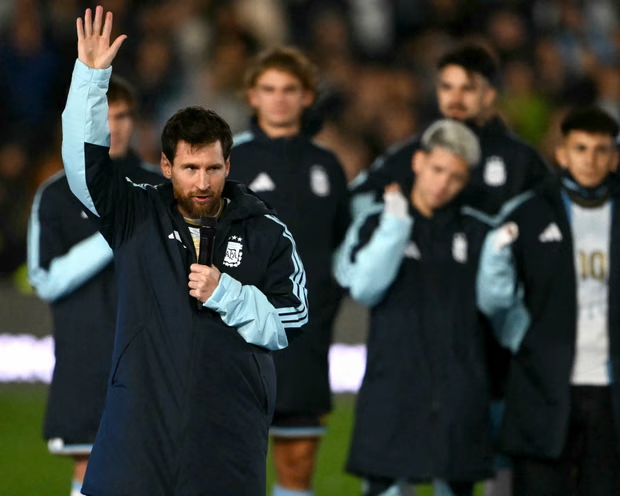
Twenty one years, 208 appearances, 126 goals, a World Cup and two Copa América titles later, Lionel Messi has finally brought the curtain down on his international career. On October 6, 2026, more than 85,000 supporters filled Buenos Aires’ Estadio Monumental to watch Argentina face Benin in what was officially a friendly, but emotionally something much bigger.
Argentina won 3 0, Messi scored from the penalty spot and played a decisive role in creating the other two goals, but by the final whistle the score line hardly mattered. This was Argentina’s opportunity to say goodbye to its captain, its number 10 and the footballer who had defined an entire generation of the national team.
Messi leaves international football as Argentina’s most capped player and its highest goal scorer, with 208 appearances and 126 goals. Yet his legacy cannot be understood through numbers alone. His journey with Argentina was never a straight line towards greatness. It was filled with criticism, heartbreak, failed finals, retirement, return and eventually redemption. That is precisely why his farewell carried so much emotion. Argentina was not simply bidding farewell to a successful footballer. It was closing one of the most complicated and extraordinary chapters in the country’s sporting history.
A Farewell That Felt Bigger Than Football
Football rarely gives its greatest players the ending they would script for themselves, but Messi came remarkably close. The first half against Benin ended without a goal, before Argentina took control after the interval. Nicolás Otamendi opened the scoring after Messi helped create the opportunity, and Nico Paz added another with Messi once again involved. Then came the moment everyone inside the Monumental had been waiting for. Argentina were awarded a penalty, Messi stepped forward and calmly scored what would become the 126th and final international goal of his career.
The atmosphere made it clear that this was not an ordinary match. Messi’s family watched from the stands, former Argentine champions were present and the stadium became the centre of a national celebration. Music, lights, fireworks and a drone show followed the final whistle, while tributes to Messi appeared across Buenos Aires and in his hometown of Rosario. The occasion resembled a state farewell more than a sporting event. For Argentina, Messi had long stopped being merely a footballer. He had become a symbol of national pride, perseverance and ultimately triumph.

Argentina Did Not Always Love Messi Like This
It is easy to forget that Messi’s relationship with Argentina was once deeply complicated. For much of his early international career, every performance was measured against Diego Maradona. Messi had left Argentina for Barcelona at a young age and developed almost entirely within Spanish football. Whenever Argentina failed, that history became part of the criticism. Supporters and commentators questioned why the player who appeared unstoppable for Barcelona could not consistently deliver the same success for his country.
The pressure became even greater after Argentina lost the 2014 World Cup final to Germany. More disappointment followed in successive Copa América finals, and after losing the 2016 Copa América final, Messi briefly announced his retirement from international football. At that moment, it seemed possible that one of the greatest players in football history could end his Argentina career without ever winning a major senior trophy for his country. But Messi returned, and that decision eventually transformed both his reputation and the history of the Argentine national team.

The Redemption That Changed Everything
The turning point came in 2021, when Argentina defeated Brazil at the Maracanã to win the Copa América. For Messi, that victory was more than a trophy. It removed the burden that had followed him for years and finally gave him the major international title that critics had repeatedly demanded. The Finalissima followed, but the defining moment arrived in Qatar in December 2022.
Argentina faced France in one of the most dramatic World Cup finals ever played. Messi scored twice during the match and Argentina eventually won on penalties. After 36 years, Argentina were world champions again. The victory changed Messi’s international legacy permanently. The question of whether he could deliver for his country disappeared. He had now done what generations of supporters had demanded and had led Argentina to the biggest prize in football. When Argentina added another Copa América title in 2024, Messi’s transformation from a player once questioned by his own country into an unquestioned national icon was complete.

One Final World Cup
Messi could easily have walked away after winning the World Cup in Qatar, but he continued. The 2026 World Cup presented one final challenge. At the age of 39, Messi helped Argentina reach another final, this time against Spain. Victory would have given Argentina consecutive World Cup titles and perhaps created the perfect ending to Messi’s international story.
That ending did not arrive. Spain won 1 0 after extra time, leaving Argentina as runners up. Yet unlike earlier defeats, this loss did not create questions about Messi’s greatness or his commitment to the national team. Those debates had already been settled. Messi had nothing left to prove. Weeks later, he announced that his international journey was reaching its conclusion, and Argentina prepared one final match so that the country could say goodbye properly.

Why the Opponent Barely Mattered
On paper, Argentina versus Benin was simply an international friendly. In reality, the opponent was almost irrelevant. The evening was designed around closure. In Rosario, a giant number 10 shirt carrying the word “Gracias” was displayed at the National Flag Memorial, while supporters gathered along the team’s route towards the Monumental. Inside the stadium, the match gradually became a celebration of everything Messi had represented for Argentina.
There were emotional scenes throughout the evening. Messi was visibly moved, and Argentina coach Lionel Scaloni also struggled to hide his emotions. Nicolás Otamendi, Messi’s teammate for many years, also ended his international career that night, making the occasion feel like the symbolic departure of an entire generation. Messi helping create Otamendi’s goal made the moment even more fitting. It was not simply one legend leaving. It was the closing of the team that had restored Argentina to the summit of world football.

The Numbers Tell Only Part of the Story
Messi’s final international record is extraordinary. He leaves with 208 appearances, 126 goals, a World Cup, two Copa América titles and a Finalissima. Those achievements alone place him among the greatest international footballers ever to play the game. But the emotional power of his story comes from everything that happened between the beginning and the end.
His senior Argentina career began in 2005 with an infamous debut against Hungary, when he was sent off only moments after entering the pitch. More than 21 years later, he stood inside a packed Monumental while tens of thousands of supporters celebrated him. Between those two moments came criticism, lost finals, public doubt, a temporary retirement, a comeback, continental glory and finally a World Cup. Messi’s greatness lies not only in what he won, but in how long it took him to win it and how many times he returned after disappointment.

Argentina Must Now Learn to Live Without Messi
For more than a generation, Argentina could build its attack around one simple idea: get the ball to Lionel Messi. That certainty has now disappeared. Argentina still possesses considerable talent, and players such as Nico Paz represent the next generation. The national team also retains the tactical foundations established during Lionel Scaloni’s successful tenure.
But replacing Messi cannot simply be treated as a tactical problem. A formation can be adjusted and positions can be filled, but a player who shaped the identity of the national team for more than two decades cannot simply be reproduced. Argentina’s next challenge is therefore not to search endlessly for another Messi. It is to create a new identity in which the team no longer depends on one extraordinary individual.

He Never Became Maradona. He Became Messi
Perhaps the most important part of Messi’s Argentina journey is that he eventually escaped the comparison that had followed him for almost his entire career. Argentina spent years asking whether Messi could become another Diego Maradona. He never did, and in the end he never needed to.
Maradona gave Argentina 1986. Messi gave Argentina 2022. They belonged to different eras and represented very different personalities, but both became permanent parts of Argentina’s national identity. Messi’s journey was arguably more complicated because acceptance did not come immediately. He had to lose finals, face criticism and even walk away from the national team before eventually returning and completing the story.

Now there is almost nothing left to debate. The World Cup was won, the Copa América titles arrived, the scoring record belongs to him and the appearance record belongs to him as well. For years, Argentina kept asking Messi for one more performance, one more trophy and one more answer. On October 6, 2026, there were no more questions left to ask. There was only one final message from a country that had finally understood exactly what it had witnessed.
Gracias, Leo.


