
Black October : How AI Exposed the Internet's Biggest Cybersecurity Weakness
Artificial intelligence was supposed to make the internet smarter and more secure. Now, the same technology is exposing vulnerabilities hidden inside its foundations for years. Two critical flaws in PHP, a programming language used by millions of websites, have triggered warnings from some of the world's most influential technology executives. Security researchers call it a breakthrough. Cybersecurity leaders fear it may be the beginning of a new era of AI-enabled hacking.


Black October: The Internet's Hidden Weakness Comes to Light
On 21 October 2026, cybersecurity researchers disclosed two critical vulnerabilities in PHP, one of the world's most widely used server-side programming languages. The flaws, identified as CVE-2026-109618 and CVE-2026-109619, were assigned severity scores of 9.2 out of 10 under the CVSS 4.0 framework. Researchers at cloud-security company Wiz demonstrated that affected configurations could allow attackers to execute malicious code remotely without first authenticating themselves. This means a vulnerable server could potentially be compromised without the attacker possessing a legitimate username or password.
The discovery became known as Black October, reflecting growing concerns that advanced AI systems could uncover longstanding software vulnerabilities faster than organisations can repair them. Wiz reported that some of the underlying programming flaws had existed for more than a decade. The breakthrough was not simply finding suspicious code; it involved using frontier AI systems to help identify complicated interactions within PHP's internal memory-management processes and develop demonstrations of how those weaknesses could be exploited.
The implications extend beyond one programming language. PHP supports widely used content-management systems, including WordPress, Drupal and Joomla. These platforms help run business websites, publishing systems and online services across the world. Because the vulnerabilities exist within PHP itself, updating individual website plugins or themes does not necessarily eliminate the underlying risk.
The PHP development team released security updates on the day of public disclosure, while the US National Security Agency urged organisations to identify affected systems and apply fixes immediately.
How Much of the Internet Depends on PHP?

The scale of PHP adoption explains why the incident generated such concern. According to W3Techs, PHP was used by approximately 69.2% of websites whose server-side programming language could be identified as of 29 October 2026. That substantial installed base means a vulnerability in PHP's core engine can potentially affect many independent applications and organisations simultaneously.
However, there is an important distinction between a website using PHP and a website remaining vulnerable. The risk depends on the installed PHP version, whether the relevant security patches have been applied and the conditions necessary to exploit the flaws.
PHP Version Distribution

The version distribution also illustrates a broader problem facing cybersecurity teams: older software remains embedded in production environments long after newer releases become available. Such systems can be difficult to upgrade because they support legacy applications, government portals and business processes that depend on specific software configurations.
What Exactly Did AI Discover?

The vulnerabilities, collectively referred to as PHP2Shell, involve memory-safety weaknesses inside the PHP engine. Under certain conditions, an error during request processing can leave internal references pointing to memory that should no longer be used. Subsequent operations can then mishandle that memory, potentially exposing sensitive information or allowing unintended execution of code.
Wiz researchers demonstrated exploitation against representative deployments of WordPress, Drupal and Joomla. They also described techniques involving PHP's internal session handling, fatal-error processing and OPcache functionality.
The central security concern is that attackers may be able to cross a boundary normally separating ordinary website requests from the server's internal execution environment. If successful, such exploitation could expose confidential data, compromise application servers or facilitate movement into connected networks.
For developers, the discovery is significant because it demonstrates that even mature, extensively reviewed programming languages can contain subtle weaknesses capable of surviving for years.
For cybersecurity professionals, the more consequential development is the role of AI in accelerating vulnerability research.
Wiz disclosed that its research incorporated AI-assisted analysis using Wiz Atlas, Gemini 4 Argon and GPT-5.6 Sol. These systems contributed to identifying and understanding defects that had previously escaped detection.
The discovery represents a new capability in defensive security research. But the same technical advances could also help malicious actors examine code, identify weaknesses and adapt attacks more rapidly.
“The future of cybersecurity may not be defined by who discovers a vulnerability first, but by who can respond before it is exploited.”
Editorial analysis, not a quotation attributed to an industry executive.
Why the World's Technology Leaders Are Alarmed
The disclosure triggered unusually forceful warnings from senior figures in the technology industry.
OpenAI CEO Sam Altman questioned whether organisations would be able to keep pace with the growing number of software vulnerabilities. Anthropic's deputy chief information security officer Jason Clinton warned of a potential “vulnerability tsunami”, suggesting that critical infrastructure operators could face severe pressure as AI accelerates vulnerability discovery.
Salesforce CEO Marc Benioff described the situation as “code red”. Cloudflare CEO Matthew Prince similarly warned that increasingly capable AI systems could examine the internet's underlying software with unprecedented persistence, creating a period of heightened cybersecurity risk. These statements were reported by The Guardian on 23 October 2026.
The concern is not that AI has suddenly invented software vulnerabilities. Many of the weaknesses already exist. The change is the speed and scale at which increasingly sophisticated tools may discover them.
Traditional vulnerability research can require substantial manual analysis, specialised knowledge and repeated experimentation. AI-assisted systems could reduce some of these barriers, enabling security researchers to investigate a much larger volume of code.
This offers substantial defensive benefits when vulnerabilities are discovered responsibly and repaired before public exploitation.
But if attackers gain similar capabilities, the period between discovery, public disclosure and attempted exploitation could become increasingly dangerous.
Millions of Attack Attempts: What Happened After the Disclosure?
The danger became visible almost immediately after PHP2Shell was publicly disclosed. According to Cloudflare CEO Matthew Prince, the company observed a rapid escalation in suspicious requests associated with attempts to exploit the vulnerabilities.
Prince reported that activity increased from thousands of attempts before the announcement to tens of thousands shortly afterwards, reaching hundreds of thousands within approximately two hours and eventually millions.
Those figures illustrate the speed with which attackers and automated scanners can respond to publicly disclosed vulnerabilities. However, an exploitation attempt is not the same as a successful system compromise. A large volume of malicious requests can be blocked, fail to trigger a vulnerability or target systems that have already been patched.
This distinction became particularly important when Wiz published a follow-up assessment on 27 October.
Its researchers reported observing exploitation attempts but said they had not identified successful compromises within the attempts captured in their telemetry. They also noted that some privately demonstrated exploitation methods remained effective against certain targets, meaning the absence of observed success could not be interpreted as proof that the vulnerability was harmless.
Has the Internet Started Recovering?

The findings reveal an important counterpoint to the more alarming industry predictions: defensive action is already reducing exposure.
Wiz recorded an approximately 67% decline in the daily number of distinct internet-exposed machines vulnerable to PHP2Shell within the first several days after disclosure. It also observed a 47.9% decline in affected organisations.
The reductions are consistent with patch deployment, software upgrades, service retirement and restrictions on internet access. The data do not establish exactly how much each defensive measure contributed.
This suggests that although AI may accelerate vulnerability discovery, coordinated defensive responses can still substantially reduce the attack surface.
The greatest uncertainty is whether defenders can maintain that pace as AI-assisted discoveries become more frequent.
From Discovery to Emergency Patching: The PHP2Shell Timeline
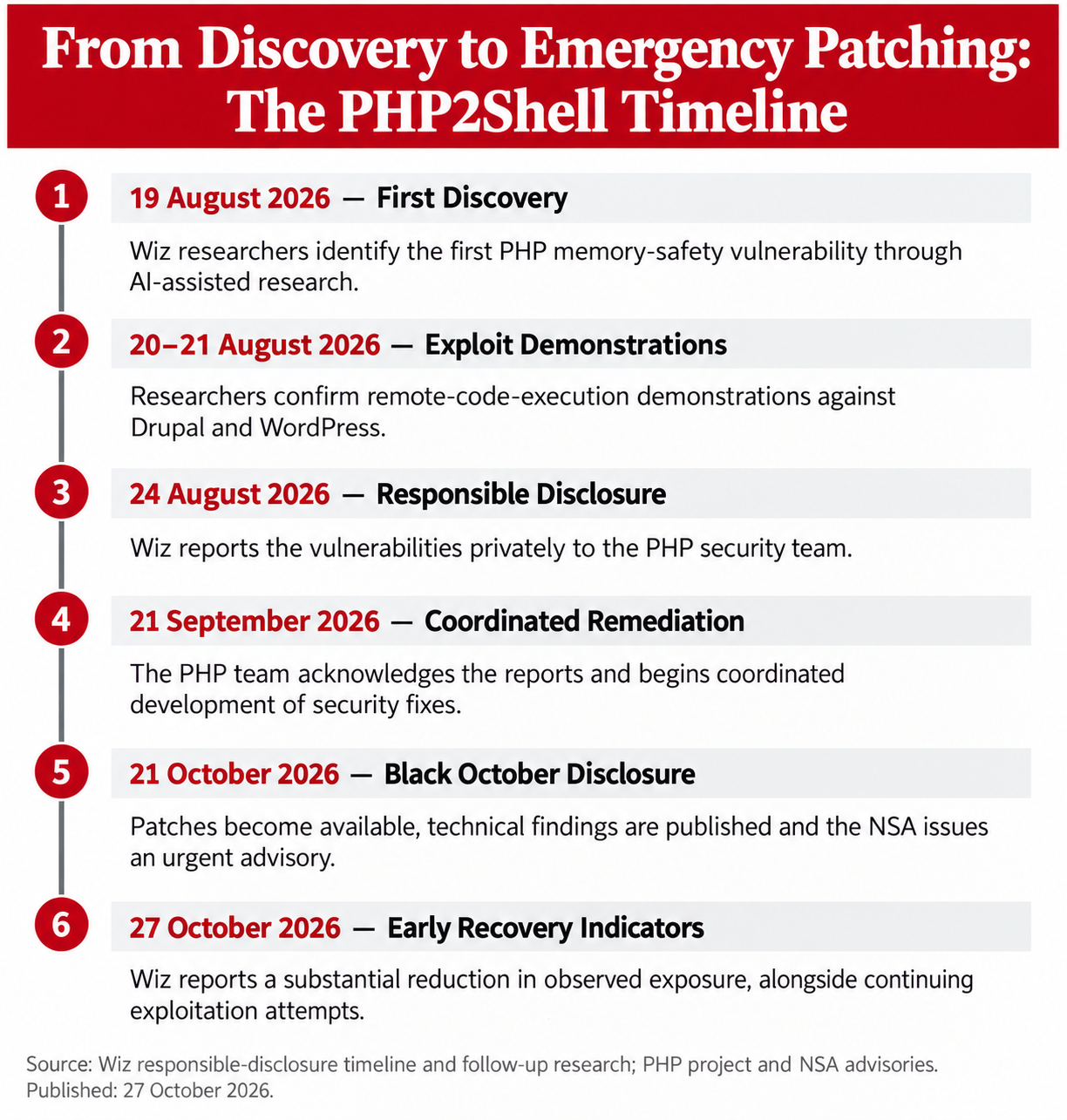
Why This Is a National Security Concern, Not Just an IT Problem

The seriousness of PHP2Shell became clear when the US National Security Agency issued a formal advisory on 21 October. The agency warned that affected PHP servers could potentially be compromised without authentication, allowing attackers to steal data, disrupt services or move into connected systems.
The NSA urged organisations to inventory vulnerable services, apply relevant patches, improve logging and replace unsupported software. Where immediate remediation was impossible, it recommended considering the temporary removal of exposed services from the internet.
The implications extend well beyond private technology companies. Government departments, financial institutions, hospitals, universities and public-service portals may rely on interconnected web infrastructure. A compromise of one exposed server can sometimes create opportunities for an attacker to reach other systems if network segmentation, access controls or monitoring are inadequate.
In a national-security context, such weaknesses could be exploited for espionage, disruption or access to sensitive information.
However, the existence of PHP2Shell does not establish that any particular government or intelligence service successfully exploited it. Public evidence of an exploit mechanism must be distinguished from verified attribution of an actual intrusion.
That distinction is particularly important as AI increases the speed at which threat reports, automated scans and unverified claims circulate online.
Implications for India: A Larger Digital Economy Means a Larger Attack Surface
India's rapidly expanding digital ecosystem makes infrastructure security a strategic priority. Government service portals, banking systems, educational platforms, e-commerce businesses and private organisations all depend on interconnected software and networks.
The risk posed by PHP2Shell is therefore relevant wherever vulnerable PHP installations are exposed to the internet. It would be incorrect, however, to assume that every Indian website using PHP is vulnerable or that the incident has resulted in a confirmed nationwide cyberattack.
The immediate priority for Indian organisations is to identify affected applications and infrastructure, deploy PHP and vendor security updates, assess unsupported systems, and strengthen monitoring for suspicious activity.
At the institutional level, the incident also underlines the importance of secure software supply chains, continuous vulnerability assessment, coordinated incident response and responsible use of AI-assisted security tools.
For India's cybersecurity ecosystem, the lesson is broader than a single vulnerability: cybersecurity planning must evolve from occasional patching towards continuous software assurance and rapid risk reduction.
Can AI Become the Internet's Greatest Defender and Its Most Dangerous Threat?

The most important lesson from Black October is that artificial intelligence is fundamentally changing the economics of vulnerability discovery.
Software weaknesses that once required substantial expert effort to identify may become easier to locate with AI assistance. Defensive researchers could use those capabilities to find defects before criminals exploit them. But attackers may also use advanced tools to investigate software, analyse security disclosures and adapt their techniques.
That creates a potential imbalance: detecting a new weakness may become faster than updating millions of affected systems.
The PHP2Shell incident demonstrates both sides of this transformation. AI helped security researchers uncover serious, longstanding flaws. At the same time, the disclosure produced rapid exploitation attempts, forcing organisations and security providers into urgent defensive action.
Yet the early reduction in vulnerable exposed systems demonstrates that coordinated remediation can still be effective.
“AI is accelerating the discovery of vulnerabilities. The challenge is ensuring that security teams can respond faster than attackers can exploit them.”
Editorial assessment based on the research findings.
Conclusion: The Next Cybersecurity Race Has Already Begun
Black October may be remembered as an important moment in the development of AI-assisted cybersecurity. The discovery of two critical PHP vulnerabilities exposed the fragility of software infrastructure on which millions of organisations depend. It also demonstrated that advanced AI can help researchers uncover complex weaknesses that have survived years of conventional security scrutiny.
The warnings from technology executives highlight a genuine concern: the volume and complexity of newly discovered vulnerabilities may increase faster than existing patch-management systems can handle.
However, the available evidence does not support the conclusion that the internet has become impossible to secure. Security updates were released, defensive action began immediately, and researchers subsequently documented substantial reductions in observed exposure.
The future of cybersecurity will not depend on preventing AI from discovering vulnerabilities. It will depend on ensuring that AI-powered defence, secure software engineering and coordinated remediation advance at least as quickly as the threats.
Black October is therefore not merely a story about a dangerous programming flaw. It is an early demonstration of how artificial intelligence is changing the balance between those who secure the internet and those who seek to exploit it.


